
A prototype tests whether people understand and want your design; an MVP tests whether they will actually use it or pay for it. If your question is about layout, flow or usability, build a low-fidelity prototype first. If your question is whether anyone will adopt or buy, run a single-feature MVP instead. We offer a complimentary app fit review if you want a second opinion before committing.
TL;DR:
- Prototypes primarily test design and usability questions, often with low to high fidelity depending on the stage, and are discarded after validation.
- MVPs focus on market and demand validation, using real, working features to measure adoption, retention, and willingness to pay over weeks or months.
- The choice between a prototype and MVP depends on whether the main risk involves understanding the interface or securing customer commitment and revenue.
- Building a full MVP prematurely can lead to wasted resources if the fundamental demand or willingness to pay is not established early.
- Cost and timeline for prototypes are shorter and lower, often a few days to weeks, while MVPs can take several weeks or months, with expenses driven mainly by integration and data requirements.
Table of Contents
- What a prototype is: types and what you learn
- What an MVP is: models and measurable outcomes
- How prototypes and MVPs differ: a decision checklist
- Timeline and cost expectations for prototypes and MVPs
- Sorting out PoC, mockup, prototype and MVP
- FlowLab’s workflow-first approach to choosing the right experiment
- Balancing speed and technical quality under resource limits
- How FlowLab turns a decision into a working build
- FAQ
- Sources
What a prototype is: types and what you learn
A prototype is a representation of a product built to test design and usability before anything is market-ready, according to the overview of software prototyping. It answers questions about desirability, usability and stakeholder alignment, not about revenue or sustained demand. The right fidelity depends entirely on what you are trying to learn.
Low-fidelity prototypes include paper sketches and basic wireframes. They are cheap, fast to change and good for testing whether a flow makes sense before anyone writes code. Mid-fidelity prototypes, such as clickable Figma flows, let you observe how someone actually navigates a screen sequence. High-fidelity prototypes, including wizard-of-Oz setups (where a human manually performs tasks the system will eventually automate) and semi-functional builds, are closer to the real product and better suited to usability testing with real tasks.
There is also a choice between throwaway and evolutionary prototypes. A throwaway prototype exists purely to answer a question and gets discarded once you have the answer. An evolutionary prototype is built with the intention of becoming part of the eventual product, which makes sense once your design assumptions are mostly settled.
Typical things a team might measure from prototype testing:
- Task completion rate: can people finish the intended action without help?
- System Usability Scale (SUS) scores, a standard questionnaire for perceived ease of use.
- Qualitative feedback: confusion points, hesitation, misread labels.
- Time on task, as a rough proxy for friction.
None of these tell you whether someone will pay. They tell you whether the design works the way you think it does, which is the entire point of this stage.
What an MVP is: models and measurable outcomes
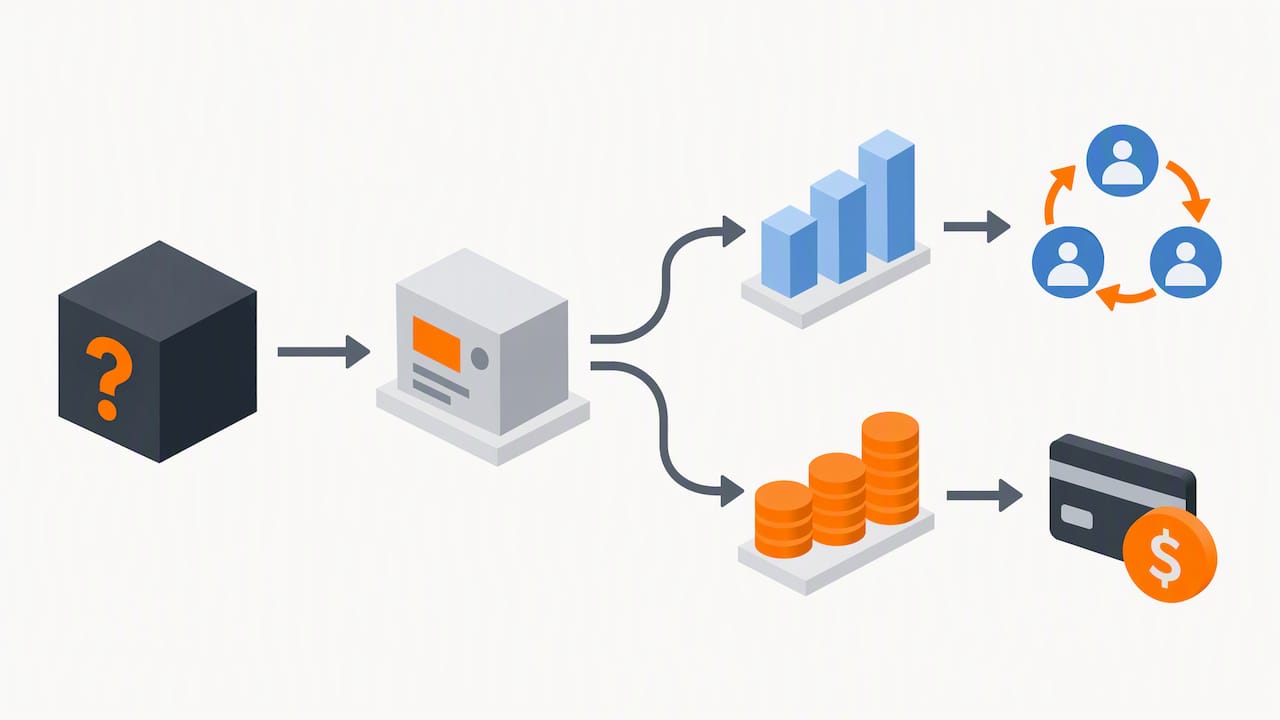
A minimum viable product is the smallest set of features that lets a team collect the maximum validated learning about customers with the least effort, as described in the minimum viable product overview. Where a prototype checks whether people understand your design, an MVP checks whether they will actually adopt it, keep using it or pay for it. The goals shift from usability to acquisition, activation, retention and revenue signals.
A few recognised MVP patterns show up repeatedly:
- Landing page or pre-sales MVP: a page describing the offer, measuring sign-ups or pre-orders before you build anything.
- Concierge MVP: you manually deliver the service behind the scenes while the customer experiences something that looks automated.
- Piecemeal MVP: you stitch together existing tools and services rather than building new ones, to test demand quickly.
- Single-feature live product: one real, working feature released to real users, with everything else stripped away.
The metrics that matter here are different from prototype metrics. Activation rate tells you whether people who sign up actually use the core feature. Conversion to paid tells you whether the value is strong enough that someone reaches for their card. Retention after the first week tells you whether the initial interest survives contact with daily use. Early cost-per-acquisition signals, even rough ones, tell you whether the economics could ever work at scale.
Industry reporting on early-stage digital projects warns that teams often fail by overplanning or by building a polished demo without testing the hard assumption, as noted in the Financial Times analysis. An MVP only earns its name if it forces contact with a real, risky question: will someone actually use this, or pay for it.
How prototypes and MVPs differ: a decision checklist
The two tools answer different questions, and mixing them up usually means building the wrong thing well rather than the right thing roughly.
| Dimension | Prototype | MVP |
|---|---|---|
| Purpose or learning goal | Design and usability validation | Market and demand validation |
| Fidelity and user experience | Low to high, not production-ready | Real, working, even if narrow |
| Target audience for testing | A handful of users or stakeholders | Real prospective customers |
| Metrics to measure success | Task completion, SUS score, feedback | Activation, conversion, retention |
| Time to initial test | Days to a couple of weeks | Weeks to a few months |
| Cost and technical debt risk | Low cost, usually discarded | Higher cost, debt if rushed |
Five questions tend to sort most teams into the right lane:
- Are we unsure whether people understand the interface, or unsure whether they want the outcome?
- Do we need feedback from a handful of people, or from real paying prospects?
- Is the risk mainly about layout and flow, or about revenue and adoption?
- Can we answer the question without writing production code?
- Would a wrong answer here cost us weeks of rework, or months of wasted investment?
A B2B workflow tool for warehouse staff, for example, usually starts with a clickable prototype: the main risk is whether staff understand the screen sequence under time pressure, not whether anyone will pay (that part is often already agreed contractually). A consumer marketplace app, by contrast, usually needs an MVP early, because the real risk is whether strangers will trust it enough to list or buy anything at all, which no prototype can answer honestly.
Pro Tip: If you cannot say in one sentence what wrong answer you are afraid of, you are not ready to build either one yet.
Timeline and cost expectations for prototypes and MVPs
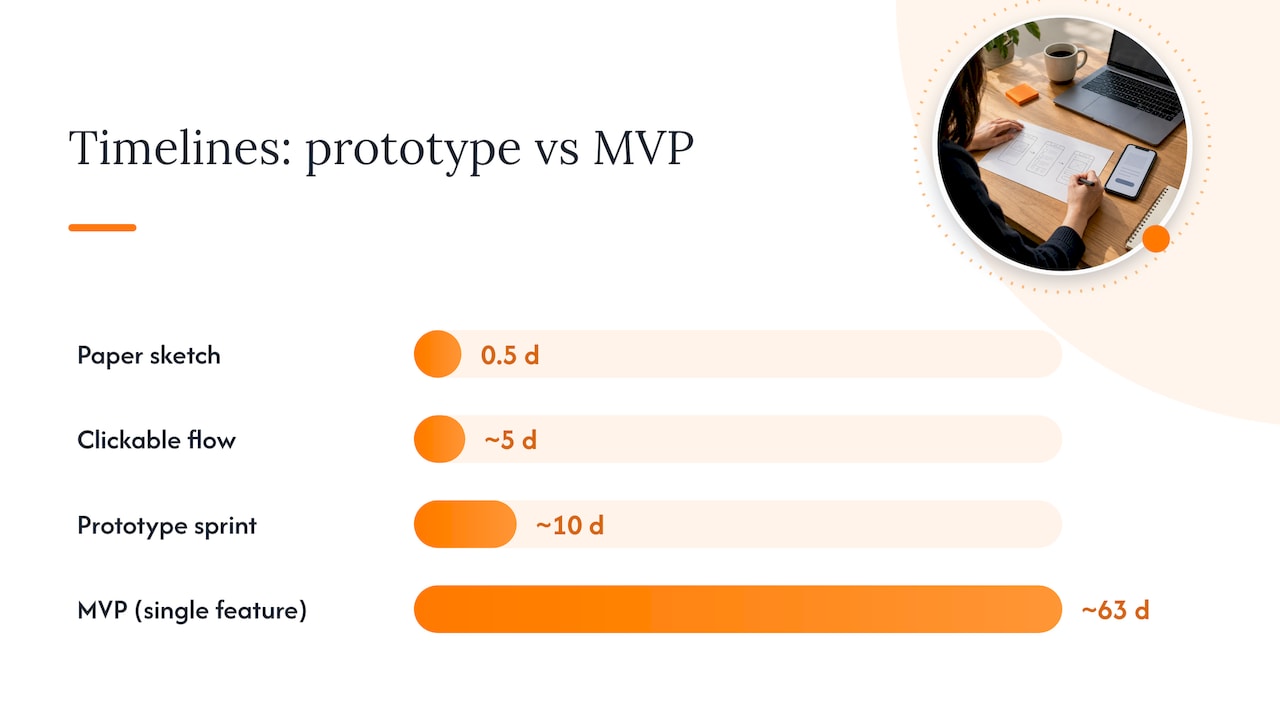
Prototype sprints typically run from a few days to two or three weeks, depending on fidelity. A paper sketch can be tested the same afternoon; a clickable mid-fidelity flow usually takes a few days to assemble and a week to test properly. MVPs run longer: a single-feature live product or a concierge model often takes several weeks to a few months, depending on how much real infrastructure it needs.
Cost drivers rarely come from the core idea. They come from:
- Integrations with existing systems, such as payment or scheduling tools.
- Data handling and storage requirements, especially anything involving personal information.
- Compliance obligations relevant to your sector.
- Recruiting the right test users, which takes longer than teams expect.
You can keep costs down without weakening what you learn: test with fewer, better-matched users rather than more random ones, and strip the build to the one feature that carries the risk. When results come back, the next move depends on what you found. A confusing prototype gets iterated, not scrapped. A promising MVP gets its scope expanded carefully, one validated step at a time. A flat result, where nobody cared enough to act, is usually a sign to stop rather than to keep refining the same idea. Website build timelines follow a similar logic: scope and integrations, not the core design, usually decide how long a project actually takes.
Sorting out PoC, mockup, prototype and MVP
The confusion is mostly about naming, not substance. A proof of concept (PoC) asks “can this be built at all technically?” A mockup asks “what will this look like?” and is usually static, with no interaction. A prototype asks “can people use and understand this?” An MVP asks “will real customers adopt or pay for this?”
Three errors follow from mixing these up:
- Treating a PoC as proof of market demand, when it only proves technical feasibility.
- Calling a static mockup a prototype, then being surprised when usability testing reveals nothing new.
- Building a full MVP to answer a question a cheap prototype could have settled in a week.
A quick reframe exercise fixes most of this: write down the exact question you are trying to answer, then ask which of the four tools above actually answers that specific question, not which one your team happens to be comfortable building.
FlowLab’s workflow-first approach to choosing the right experiment
We start every enquiry by reviewing the operational workflow behind the request, not the feature list someone has already sketched out. That review usually surfaces the real hypothesis hiding underneath: is the risk about whether staff can use a new screen, or about whether a process will actually get adopted once it is live? From there we point towards the experiment that answers it, rather than the one that happens to be easiest to scope.
Prototypes create a shared language between business, design and engineering, reducing the kind of misunderstanding that only surfaces once development is already underway.
If you want that review done on your own situation, our complimentary app fit review and product demos are both available to try before anything is committed.
Pro Tip: Write your hypothesis, chosen experiment, tracked metric and outcome in one line each before you start. It keeps the test honest and the result easy to act on.
Balancing speed and technical quality under resource limits
Technical debt is acceptable when you are still answering whether anyone wants the thing at all; it is not acceptable once real customers depend on it daily. We would rather see an SME ship a rough single-feature MVP this month than spend three months perfecting a feature nobody has asked to use yet.
The one rule worth keeping: never let polish outpace proof. If you are genuinely unsure which experiment answers your question, run the five-question checklist above, or get a second opinion through an app fit review before committing a budget.
— Ronald
How FlowLab turns a decision into a working build
Once you know whether you need a prototype or an MVP, the next problem is usually execution, not strategy. We offer custom web apps, internal business tools, workflow automation and product customisation, built after a workflow-first review that identifies the simplest route to an answer, whether that means adapting an existing product or building something from scratch.
Several of our product lines double as ready single-feature MVPs rather than ground-up builds. LeadsFlow gives every enquiry an owner and a next move, which works well for testing a sales process hypothesis. POSFlow runs a sample sale from product to payment, useful for validating a retail flow. PresenceFlow turns attendance into a live operating view, and PriceFlow gives the right product answer right when staff need it. Book a complimentary app fit review and we will tell you plainly which route fits, and roughly what it will cost, before you commit to anything.
FAQ
Are MVP and prototype the same thing?
No. A prototype tests whether people understand and can use a design, usually without real functionality behind it. An MVP is a working product, however small, built to test whether real customers will adopt or pay for it.
What is considered a prototype?
A prototype is any representation of a product, from a paper sketch to a semi-functional build, created to test usability or design before the product is market-ready, as described in the overview of software prototyping. Fidelity varies depending on the question being tested.
What is the difference between a mockup and a prototype?
A mockup is a static visual representation of what a product will look like, with no interaction. A prototype adds interactivity, letting someone click through or operate a flow, which makes it useful for usability testing rather than visual review alone.
What is an MVP in game design?
The same core idea applies: the smallest playable version of a game that tests whether the core mechanic is engaging enough to hold a player’s attention, before investing in art, levels or polish. It follows the same validated-learning logic as any other MVP.
What is the difference between MVP and proof of concept?
A proof of concept checks whether an idea is technically possible at all. An MVP checks whether real customers want and will use that idea once it exists, which is a market question rather than a technical one.