
Most Singapore SMEs meet the baseline PSG grant eligibility rules: registered and operating locally, at least a significant portion of local shareholding at the ultimate beneficial owner level, and a group turnover within the eligibility threshold or group headcount within the eligibility threshold. The rule that trips people up isn’t eligibility itself. It’s timing: you must submit your application on the Business Grants Portal before you pay a deposit or sign anything with a vendor.
TL;DR:
- Applications must be submitted before making any payments, deposits, or signing contractual agreements with vendors to avoid rejection.
- Group turnover and employment are assessed across all related entities, with ownership structures and shareholdings verified through official documentation.
- Solutions must be listed on the PSG Solution Listing and used directly by the applicant business in Singapore, not as a reseller or for offshore operations.
- Changes in shareholding, group size, or payment timing after application can invalidate a valid initial approval, requiring revalidation.
- Consulting services like Flowlab help map projects against PSG categories and stage quotations to ensure compliance before formal application.
Table of Contents
- What is the PSG grant eligibility checklist?
- How does the ‘group’ and local shareholding test actually work?
- Which solutions qualify, and why must they be used in Singapore?
- What are the exact steps to apply on the Business Grants Portal?
- Why do PSG applications get rejected, and how do you avoid it?
- FlowLab’s approach to PSG-ready app projects
- Get a PSG-ready quotation without the guessing
- Sources
What is the PSG grant eligibility checklist?
Before you talk to any software vendor, run your business through four tests. Miss one, and the application gets rejected regardless of how good your case looks on paper.
- Registration and operations: your business must be registered and actively operating in Singapore, not a dormant entity or a shell used for other purposes.
- Local shareholding: at least 30% local shareholding, held by Singapore citizens or permanent residents, tested at the ultimate beneficial owner level rather than the name on the share register.
- Group size: group annual turnover of S$100 million or less, OR group employment of 200 or fewer. Only one condition needs to be satisfied, not both.
- Solution use: the solution must be used in Singapore, by your own business, and must appear on the pre-approved PSG Solution Listing.
Some entity types sit outside PSG entirely regardless of turnover or shareholding. Charities, Institutions of a Public Character, statutory boards, and certain listed companies don’t qualify under standard PSG rules. If your structure includes a trust, a foreign parent, or a recent restructuring, don’t assume you pass. Pull your ACRA business profile, your latest shareholder register, and your group financials before you approach a vendor. That paperwork forms the backbone of your application anyway, so gathering it early saves a scramble later.
How does the ‘group’ and local shareholding test actually work?
EnterpriseSG doesn’t look at your standalone entity in isolation. It aggregates turnover and employment across your entire corporate group, and it traces shareholding through every layer of ownership to find the real individuals behind it. A Singapore-registered trading arm of a larger regional group can fail the size test even if the local unit itself is small, because the parent’s global headcount or revenue gets counted in.
The shareholding test works the same way. An intermediate holding company doesn’t count as a “local shareholder” on its own. What matters is whether the people who ultimately own that holding company are Singapore citizens or PRs, and whether their combined stake clears 30%. Offshore holding structures, common among family businesses with regional operations, are where most applicants get caught out.
To check this properly:
- Request a full corporate structure chart from your company secretary, not just the top-level share register.
- Calculate group turnover and headcount using the most recent audited or management accounts across all related entities.
- If ownership runs through two or more corporate layers, get your accountant or corporate secretary to confirm the UBO breakdown in writing before you apply.
Pro Tip: Don’t rely on memory or an old organisational chart. Ownership structures shift after funding rounds or family transfers, and EnterpriseSG tests the structure as it stands at the time of application, not what it looked like when the company was founded.
Which solutions qualify, and why must they be used in Singapore?
PSG only funds solutions listed on the Business Grants Portal’s Solution Listing, so vendor claims alone mean nothing. Search the listing directly, filter by sector or function, and check the solution code matches what your vendor is actually proposing. Vendor approval status can change, so it’s worth verifying on the portal rather than trusting a quote sheet, and capturing a screenshot with the date, vendor name, and solution code for your own records.
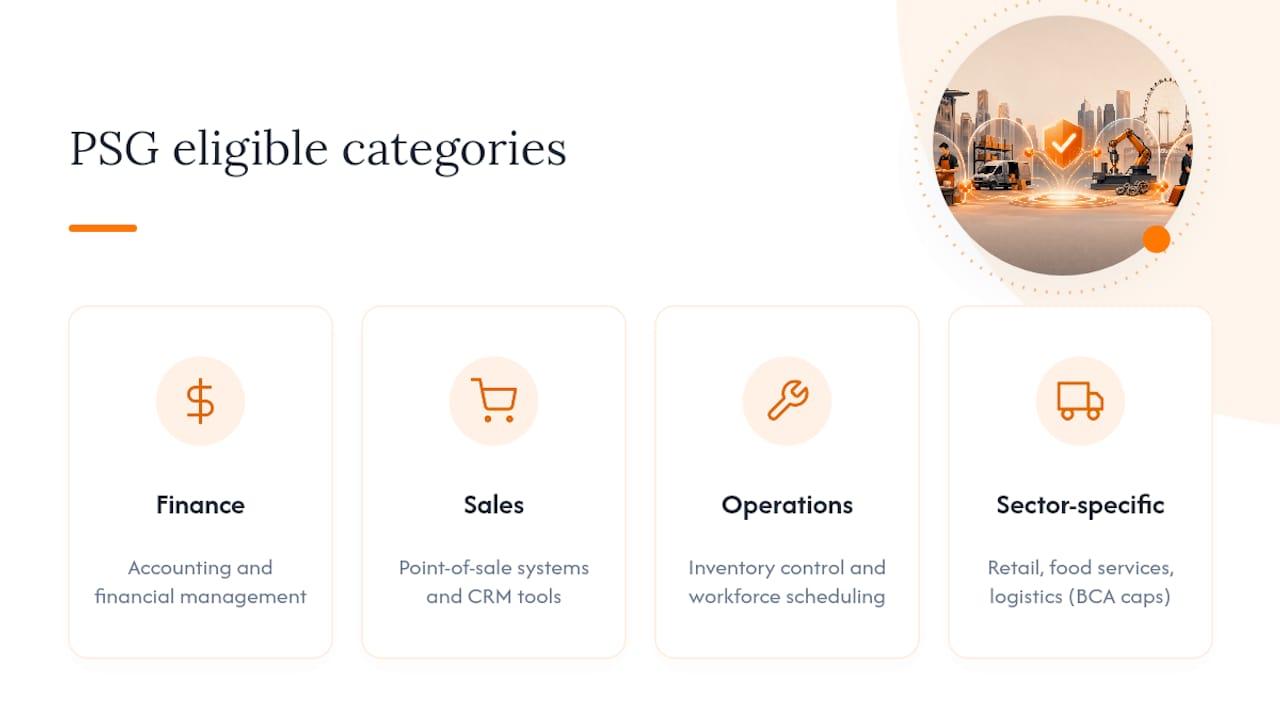
Eligible categories span a wide spread of business functions: accounting and financial management, point-of-sale systems, inventory and stock control, workforce management and scheduling, customer relationship tools, and sector-specific solutions for retail, food services, and logistics. Sector-scoped programmes, such as the Built Environment PSG administered through BCA, carry their own caps and conditions on top of the general rules.
The “used in Singapore” requirement isn’t a formality. EnterpriseSG expects your business to be the actual end user of the solution, not a reseller or a local entity acquiring software primarily to serve an overseas parent or affiliate. If the tool sits on a server here but the operations it supports run offshore, that’s a red flag an assessor will catch.

What are the exact steps to apply on the Business Grants Portal?
The sequence matters as much as the content. Get any step out of order and the whole application can be voided.
- Get a quotation from a vendor whose solution is confirmed on the PSG Solution Listing, marked clearly as non-chargeable and contingent on grant approval.
- Submit your application on the Business Grants Portal before making any payment, deposit, or signed commitment. This is the step most applicants get wrong.
- Accept the Letter of Offer once EnterpriseSG approves the application, which formalises the grant terms.
- Proceed with the vendor and submit your claim after the solution is implemented and paid for, supported by invoices and proof of payment.
Submission requires CorpPass authentication, and the person submitting needs the correct assigned role. Check this early. A director assuming they can log in and submit, only to find their CorpPass role doesn’t cover grant applications, is a common last-minute delay.
Why do PSG applications get rejected, and how do you avoid it?
The single biggest cause of rejection is applying after the fact. Even a small deposit, a signed purchase order, or an informal written agreement dated before your application submission date is enough to void the entire claim. EnterpriseSG treats the application date as a hard line: anything chargeable or contractually binding must fall after it, with no exceptions for goodwill payments or “just to secure the vendor’s schedule.”
Eligibility isn’t a one-time check either. Changes to your shareholding or group size between application and claim disbursement can invalidate a claim that was perfectly valid at the outset. A funding round, a shareholder buyout, or a merger mid-project all warrant a fresh eligibility review before you submit your claim.
- Confirm no payments, POs, or signed agreements exist before your BGP submission date.
- Re-check shareholding and group size figures at claim stage, not just at application.
- Match your chosen solution’s sector code to your actual business activity to avoid mismatch rejections.
Pro Tip: Structure vendor quotations with a “contingent on PSG approval” clause and keep all chargeable milestones scheduled after your Letter of Offer date. It’s the cleanest way to protect your application from an accidental early payment.
FlowLab’s approach to PSG-ready app projects
Most SMEs don’t fail PSG eligibility on paper. They fail it operationally, by moving faster than the paperwork allows. Flowlab’s complimentary app fit review starts by mapping the proposed work against pre-approved PSG solution categories before any quotation is finalised, so you know where you stand before a vendor conversation even locks in a price.
We stage project scope deliberately: quotations are issued as non-chargeable and contingent on approval, and no chargeable milestone is scheduled until the Letter of Offer is in hand. That sequencing exists precisely because the application date has to sit before anything binding, not after. Flowlab has worked with SME clients across retail and service sectors navigating this exact staging problem.
— Ronald
Get a PSG-ready quotation without the guessing
Working out which category your project falls under, and whether your quotation timing protects your eligibility, is where most SMEs lose momentum. Flowlab handles that mapping directly: a free app fit review checks your proposed solution against pre-approved PSG categories, structures the quotation as non-chargeable and contingent on approval, and stages any development work so nothing chargeable happens before your Business Grants Portal submission clears.

If you’re weighing a queue management system, a staff-facing operational tool, or a fully custom build, it’s worth seeing what a PSG-aligned project actually looks like before committing to anything. Try the complete queue journey demo or look at Flowlab’s app development service for SMEs to see how a scoped, staged project gets structured from quotation through to claim. Book a free app fit review and get a written mapping of your project against PSG categories before you sign anything with anyone.